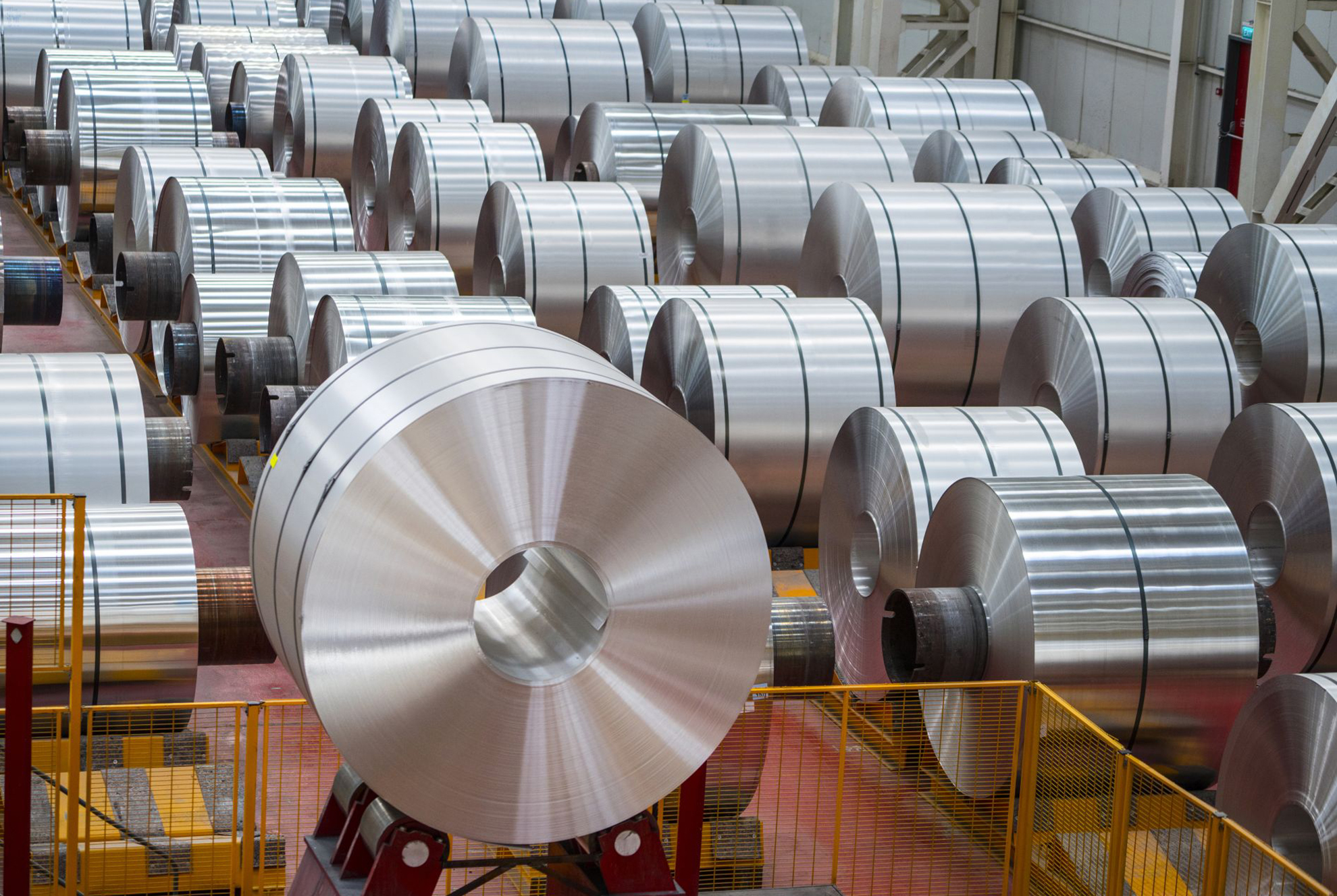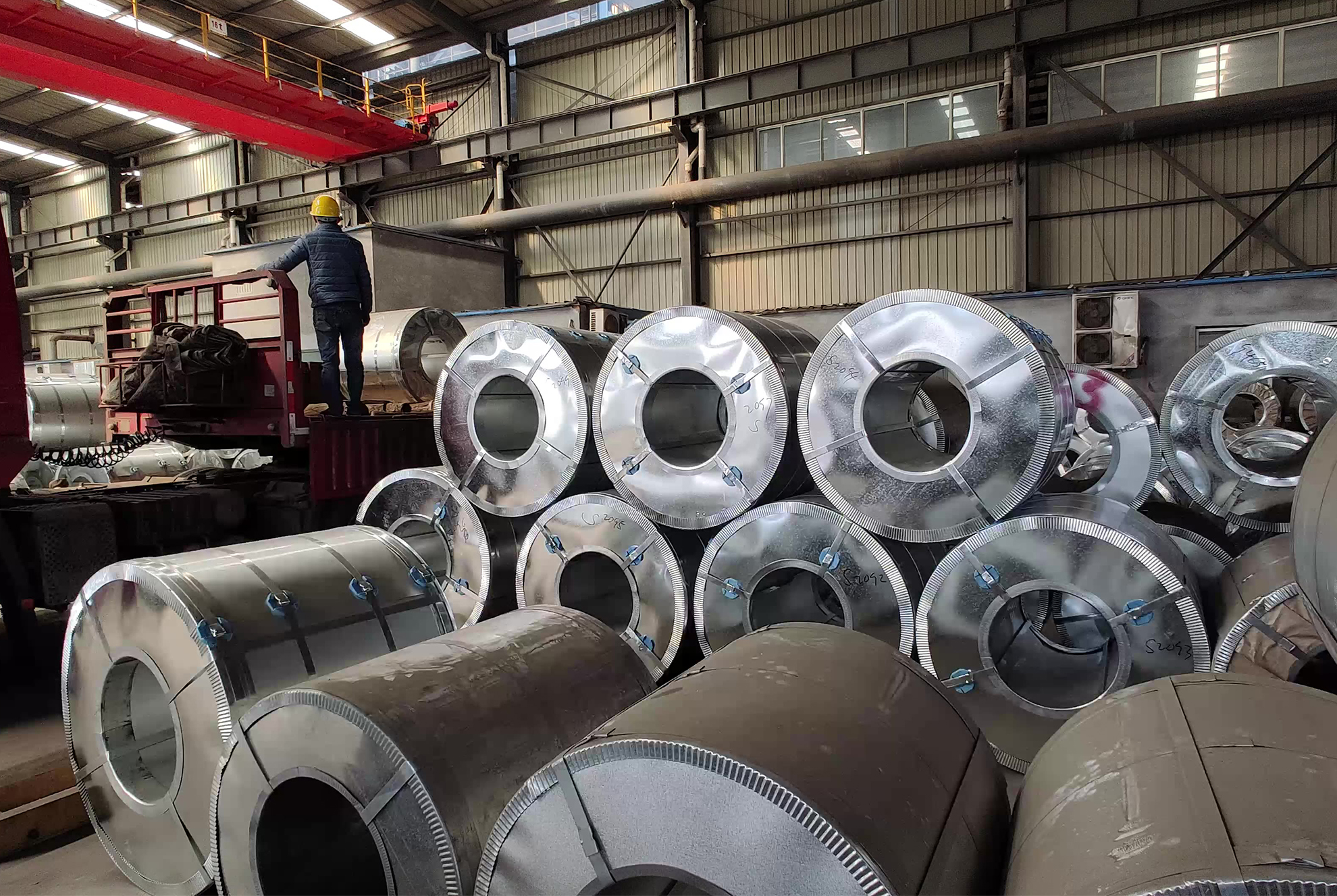
Grain-oriented (GO) electrical steel is a cold-rolled Fe–Si alloy whose crystal grains are aligned along the rolling direction, so the material carries magnetic flux most efficiently along the strip length — which is precisely why it is the core material for wound cores (C-cores, toroidal cores) and stacked transformer cores.
The shorthand "23/80" that circulates in RFQs and mills' price lists decodes as:
A critical clarification that separates competent suppliers from catalogue copy-pasters: 0.23 mm / 0.80 W/kg is NOT conventional M3. In the ASTM A664/A876 shorthand, M3 is a 0.23 mm *thickness class* with a conventional-tier loss of roughly 1.05 W/kg at P1.7/50. To reach 0.80 W/kg at the same gauge, the steel must be produced on the high-permeability (Hi-B) route — a sharper Goss texture raising B8 above 1.88 T — and typically with laser or additional domain refinement, which subdivides magnetic domains and suppresses anomalous (excess) eddy loss. That is one more controlled manufacturing operation, which is why it costs more than conventional CGO — and why quoting it as "M3" produces a price that is not comparable.
| Property | Guaranteed (typical mill spec) | Typical delivered value | Test basis |
|---|---|---|---|
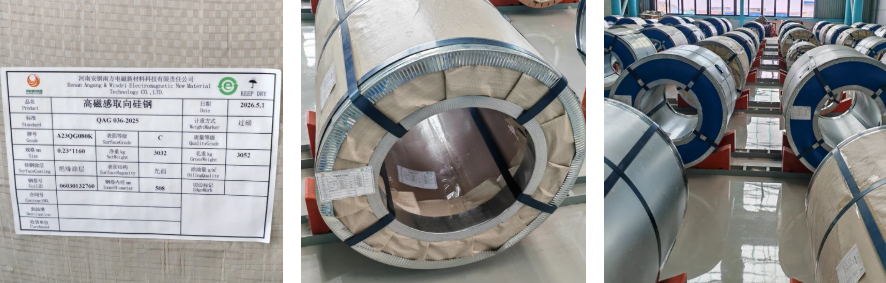
| Nominal thickness | 0.23 mm | 0.23 ± tolerance | Weight/ micrometer, IEC 60404-3 |
| Core loss P1.7/50 | ≤ 0.80 W/kg | 0.76–0.78 W/kg | Epstein or SST, IEC 60404-2 |
| Core loss P1.7/60 | — | ≈ 1.04 W/kg | Epstein, 60 Hz |
| Core loss P1.5/50 | — | ≈ 0.58 W/kg | Epstein |
| Induction B8 (800 A/m) | ≥ 1.88 T | 1.90–1.93 T | IEC 60404-3 |
| Stacking factor (wound core) | ≥ 0.95 | 0.95–0.96 | — |
| Tensile strength (rolling dir.) | — | ≈ 354 MPa | — |
| Vickers hardness | — | ≈ 205 HV1 | — |
| Density | — | 7.65 g/cm³ | — |
| Resistivity | — | ≈ 53 × 10⁻⁸ Ω·m | — |
| Coil ID / width | 508 mm ID standard | width up to ~1,250 mm; slit to order | — |
| Insulation coating | C5 inorganic (standard) | C6 inorganic-organic on request | — |
Buyers usually arrive at 0.23 mm with a loss budget in hand. The four grades below cover the practical selection range for thin-gauge Hi-B material — all share the same 0.23 mm gauge and B8 ≥ 1.88 T class induction; they differ in how much domain refinement the strip received.
| Shorthand | Thickness | Max P1.7/50 | Typical Chinese-mill grades | Close cross-refs | Best for |
|---|---|---|---|---|---|
| 23/75 | 0.23 mm | 0.75 W/kg | B23R075 / 23ZDKH75 class | M075-23P; 23P075 | Premium power & instrument transformers with the tightest no-load-loss budgets |
| 23/80 | 0.23 mm | 0.80 W/kg | B23R080 / 23ZH080 | M080-23P; 23P080; M-3 class gauge (Hi-B tier) | High-efficiency C-cores, toroidal CT/VT cores, low-loss reactors |
| 23/85 | 0.23 mm | 0.85 W/kg | B23P085 / 23ZH85 | M085-23P; 23P085 | Cost-optimized high-efficiency cores |
| 23/90 | 0.23 mm | 0.90 W/kg | B23P090 / 23ZH90 | M090-23P; 23P090 | Volume production where loss spec is relaxed one step |
We supply the 23/xx ladder in four forms, from raw material to finished core, all of Chinese-mill origin:
Core loss in CRGO has three components: hysteresis loss (set by texture, chemistry and stress state), classical eddy loss (proportional to thickness² and frequency²), and anomalous/excess eddy loss (set by domain wall spacing — what domain refinement attacks).
Halving thickness from 0.30 mm to 0.23 mm cuts the classical eddy component by roughly (0.23/0.30)² ≈ 41% relative reduction — the dominant reason thin gauge wins in wound C-cores and toroids, where the flux path runs continuously along the rolling direction and every watt of core loss burns 24/7.
Worked example — a 5 kVA toroidal transformer with a 6.5 kg core:
At a typical industrial electricity cost of USD 0.10/kWh, the thin-gauge core saves ≈ USD 31 per transformer per year. If your annual volume is 2,000 units, the material premium for 0.23 mm / 0.80 pays back in months — and after that it is pure margin in your product's efficiency rating. This is the calculation your own customer (the transformer maker) runs against you; winning it requires the right grade, not the right adjective.
For applications above 50/60 Hz (400 Hz avionics, high-frequency reactors), 0.23 mm remains viable; for frequencies beyond that, ultra-thin GO (0.05–0.20 mm) is the correct tier — available on request.
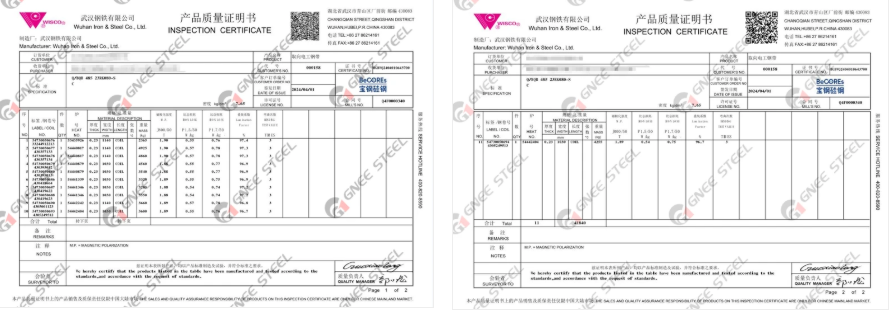
GNEE Steel is a specialist supplier of grain-oriented and non-oriented electrical steel, supplying WISCO and Baosteel Hi-B and domain-refined grades to transformer and electrical equipment manufacturers worldwide. For 27QG100 we offer:
Whether you are specifying material for a new distribution transformer platform, sourcing wound-core stock, or need a steady monthly supply of 27QG100 coils for production, our team can provide quotations, mill certificates and technical data sheets tailored to your specification.
Request a quote today — tell us your width, thickness tolerance, coil weight, coating requirement and destination port, and we will respond with a firm offer and current mill availability.
What is the difference between B23R080, 23ZH080 and 23ZDKH80?
Different producers' codes for the same performance class: B23R080 (Baosteel, laser-domain-refined), 23ZH080 (Baosteel Hi-B), 23ZDKH80 (Nippon Steel Hi-B with domain refinement). Guaranteed values are confirmed per batch on the MTC; we match your datasheet to the closest mill grade before quoting.
What core loss can I expect at 60 Hz?
Typical P1.7/60 for the 0.23/80 class is ≈ 1.04 W/kg (vs. 0.80 W/kg at 50 Hz). For 60 Hz designs, ask for the 60 Hz Epstein data with the MTC.
Why must toroidal cores be annealed after winding?
Slitting and winding introduce plastic strain that degrades permeability and raises loss. Stress-relief annealing under inert gas after winding restores the magnetic properties to (near) strip-certificate level. Cores that skip this step can run 10–30% lossier than the strip certificate suggests.
*Technical disclaimer: Values marked "typical" are indicative production statistics, not guaranteed values. Guaranteed electromagnetic properties are stated per grade code on the mill test certificate for each production batch. Cross-standard grade references are close equivalents, not identical specifications. Operating temperature, coating compatibility and finished-core magnetic values must be confirmed against your drawing before order.*