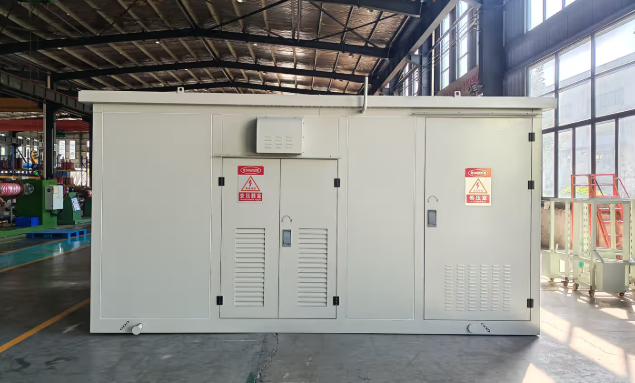
What Is No-Load Loss in a 1600kVA Transformer?
No-load loss, also widely known as core loss, is the fixed power consumption of a 1600kVA oil-immersed transformer when the secondary side has zero load and the primary winding is fully energized. Unlike load loss that fluctuates with operating load, no-load loss runs
24 hours a day, 365 days a year as long as the transformer is connected to the power grid, making it a permanent and hidden energy cost for industrial power distribution systems.
For 1600kVA distribution transformers — the most mainstream capacity for industrial factories, solar power stations, and industrial parks — no-load loss consists of two core components: hysteresis loss and eddy current loss inside the silicon steel core. Hysteresis loss accounts for 60% to 70% of total core waste, caused by repeated magnetic field reversal during power operation, while eddy current loss comes from internal circulating current and core heat generation. Since the 1600kVA model adopts a large-volume iron core, its absolute no-load power consumption is far higher than small-capacity transformers, leading to more obvious long-term electricity waste.
.png)
The 4 Real Reasons Why 1600kVA Transformers Have Excessively High No-Load Loss
Most users are confused about why their 1600kVA transformers consume massive idle power even with no production load running. The excessively high no-load loss is never caused by a single factor, but results from material, craftsmanship, model selection, and equipment aging problems. Below are the four root causes verified by power equipment engineers.
1. Low-grade ordinary silicon steel core material Many cost-oriented 1600kVA transformers on the market adopt traditional low-permeability silicon steel sheets instead of high-grade thin grain-oriented steel. This low-quality core has a large magnetic hysteresis loop, poor magnetic conductivity, and severe magnetic flux leakage, directly triggering extremely high hysteresis loss — the primary cause of excessive no-load waste for standard S11 1600kVA transformers.
2. Unoptimized core lamination and structural process The 1600kVA transformer has a large core cross-sectional area and overall volume. Products with backward manufacturing processes have uneven core lamination, excessive air gaps between steel sheets, and unreasonable lap joint design. These structural defects greatly increase magnetic leakage and eddy current loss, making the no-load loss exceed the national standard by 10%–20% in actual operation.
3. Improper model selection for long-term continuous operation A large number of industrial users blindly choose conventional S11 1600kVA transformers to save initial procurement costs. However, S11 series is not designed for 24/7 continuous energized operation. For factories, photovoltaic power stations, and industrial parks with year-round standby power demand, the inherent high no-load loss of S11 models will be infinitely magnified, forming huge hidden electricity costs.
4. Aging and damp insulation of old 1600kVA transformers After 5–10 years of operation, old 1600kVA transformers will face core aging, insulation moisture, and loose lamination. These aging problems destroy the stable magnetic circuit structure, continuously increase core eddy current loss, and make no-load loss far higher than the factory design value, accompanied by persistent core overheating.
S11 vs S13 1600kVA Transformer No-Load Loss Data Comparison
The difference in no-load loss between S11 and S13 1600kVA transformers is the core basis for energy-saving selection. S13 ultra-low loss transformers adopt upgraded high-permeability silicon steel cores and optimized lap joint technology, achieving a 30%+ reduction in no-load loss compared with traditional S11 models, which brings huge long-term energy-saving benefits. The authoritative standard comparison data is as follows:
| 1600kVA Transformer Model |
Standard No-Load Loss (W) |
Annual No-Load Power Consumption (kWh) |
Energy-Saving Rate |
Core Feature |
| S11 1600kVA |
920 |
8,060+ |
Baseline (0%) |
Ordinary silicon steel, conventional lamination |
| S13 1600kVA |
640 |
5,600+ |
≈30% Energy Saved |
High-permeability thin silicon steel, optimized core structure |
From the data contrast, a single S13 1600kVA transformer can save nearly
2,500 kWh of idle electricity every year compared with the S11 model. For industrial parks and power stations equipped with multiple 1600kVA transformers, the cumulative annual power saving is extremely considerable, and the cost recovery cycle of upgrading to S13 is usually only 2–3 years.
Best Solutions to Reduce 1600kVA Transformer No-Load Loss
Aiming at the high no-load loss problem of 1600kVA transformers, temporary maintenance cannot solve the fundamental problem. The following targeted solutions can completely reduce core loss and eliminate long-term idle power waste for different working conditions.
1. Replace traditional S11 with S13 ultra-low loss 1600kVA transformer This is the most effective and thorough solution. S13 1600kVA transformers adopt imported high-magnetic-density silicon steel sheets and stepped lap core technology, which greatly reduces magnetic hysteresis and eddy current loss. It perfectly adapts to 24/7 continuous energized scenarios and is the standard energy-saving model for current industrial and new energy projects.
2. Eliminate non-standard low-quality core equipment For refurbished and low-priced 1600kVA transformers with unqualified core materials, direct replacement is recommended. Unqualified low-grade cores will cause irreversible high loss, and later maintenance cannot restore standard energy efficiency, which will only increase long-term operation costs.
3. Optimize power operation and capacity matching Avoid long-term no-load standby of multiple 1600kVA transformers. For intermittent production factories, reasonably switch transformer operation modes according to load changes to reduce continuous energized time. At the same time, avoid unreasonable capacity matching to prevent additional loss caused by long-term light load.
4. Regular professional maintenance for in-service transformers For qualified in-service 1600kVA transformers, conduct annual core inspection, insulation drying, and fastening lamination maintenance to avoid loss increase caused by damp aging and loose core structure, maintaining stable low-loss operation for a long time.
Conclusion
The high no-load loss of 1600kVA transformers is mainly caused by low-grade core materials, backward manufacturing processes, unreasonable model selection, and equipment aging. As a large-capacity power distribution device running continuously all year round, the 1600kVA model’s idle power waste is far more serious than small-capacity transformers, becoming a key hidden item of industrial power consumption costs.
Traditional S11 1600kVA transformers are only suitable for intermittent working conditions. For new energy power stations, 24-hour continuous production factories, and standardized industrial park projects, upgrading to
S13 ultra-low loss 1600kVA transformers is the most cost-effective solution, which can significantly reduce annual electricity bills, meet energy-saving and low-carbon assessment standards, and extend equipment service life.
If you are troubled by high no-load loss of your 1600kVA transformer,
contact our professional engineering team. We provide
free energy-saving calculation, model selection consultation, and customized factory quotation for S13 1600kVA transformers, with spot supply and complete certification support.
FAQ
1. How much power does a 1600kVA transformer waste in no-load state every year?
A standard S11 1600kVA transformer wastes about 8,060 kWh of electricity per year under no-load condition, while the upgraded S13 model only consumes about 5,600 kWh, saving nearly 2,500 kWh of idle power every year.
2. Is it necessary to upgrade S11 1600kVA to S13 ultra-low loss type?
It is highly recommended for long-term continuous operation scenarios. Although the S13 model has a slightly higher procurement cost, it can recover the price difference through energy saving in 2–3 years, and the long-term operation profit is far higher than the initial cost investment.
3. Can transformer maintenance reduce the no-load loss of 1600kVA equipment?
Regular maintenance can suppress the loss increase caused by aging and dampness and restore standard operating efficiency, but it cannot solve the inherent high loss problem of S11 low-standard core structures. Fundamental replacement is required for obvious excessive loss.
4. What scenarios are suitable for S13 1600kVA low-loss transformers?
It is the best choice for solar and wind power stations, 24-hour operating industrial factories, industrial parks, commercial complexes, and EPC projects with strict energy-saving assessment requirements.
5. Do you have spot S13 1600kVA transformers with complete certificates?
We have sufficient spot inventory of S13 1600kVA ultra-low loss transformers, supporting fast delivery, custom processing, and complete MTC, IEC, and third-party test reports to meet global project bidding and export requirements.